
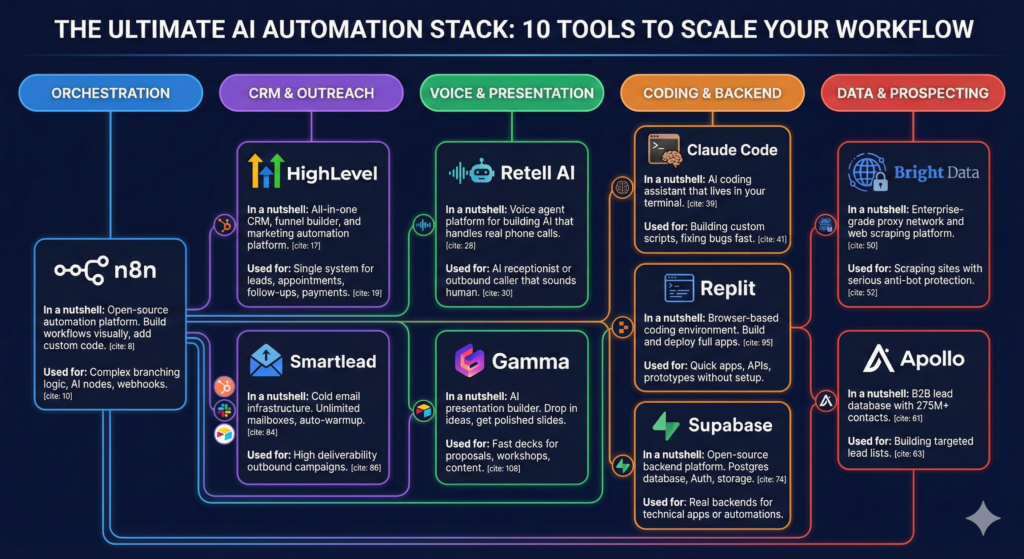
In the fast-paced world of AI automation, your capabilities are often defined by your stack. Whether you are building internal systems or shipping products for clients, relying on the right infrastructure is non-negotiable.
We have compiled a list of 10 essential tools that cover every stage of the automation lifecycle—from backend logic and lead generation to voice agents and rapid deployment.
1. The Orchestrator: n8n
n8n is an open-source automation platform that serves as the backbone for serious engineering. Unlike rigid no-code tools, it allows you to build visual workflows while injecting custom code whenever necessary.
Best Use Case: Handling complex branching logic, AI nodes, and webhooks.
Why We Love It: It offers self-hosting for full control and integrates seamlessly with HubSpot, Slack, and Gmail.
2. The All-in-One CRM: HighLevel
HighLevel replaces the need for “juggling 10 different tools” by combining a CRM, funnel builder, and marketing automation into a single platform.
Best Use Case: Managing leads, appointments, and payments in one unified system.
Key Integrations: Meta, Make, Slack, and Twilio.
3. The Voice Agent: Retell AI
When text isn’t enough, Retell AI lets you build AI voice agents that can navigate real phone conversations, answer questions, and book appointments.
Best Use Case: Deploying AI receptionists or outbound callers that sound human.
Key Integrations: n8n, Airtable, Twilio, and Google Sheets.
4. The Coding Assistant: Claude Code
Claude Code is an AI assistant that lives directly in your terminal, allowing you to write, debug, and ship code without leaving the command line.
Best Use Case: Writing custom scripts and shipping features fast—a superior alternative to copy-pasting from web-based chatbots.
Key Integrations: GitHub, Vercel, Docker, and Supabase.
5. The Data Engine: Bright Data
Bright Data is an enterprise-grade proxy network and scraping platform designed to access websites that block standard bots.
Best Use Case: Scraping high-security sites like LinkedIn or Google using pre-built scrapers and unblocking tech.
Key Integrations: n8n, CrewAI, and Make.com.
6. The Prospector: Apollo
With a database of over 275 million contacts, Apollo is the go-to source for B2B leads, offering verified emails and direct dials.
Best Use Case: Building targeted lead lists filtered by tech stack, funding stage, and job title.
Key Integrations: Clay, HubSpot, and Salesforce.
7. The Backend: Supabase
Supabase offers an open-source backend including a Postgres database, authentication, and real-time updates.
Best Use Case: Building real backends for apps when Airtable isn’t technical enough.
Key Integrations: n8n, Resend, and Stripe.
8. The Outreach System: Smartlead
Smartlead provides cold email infrastructure with unlimited mailboxes and auto-warmup to ensure your messages hit the primary inbox.
Best Use Case: Running high-volume outbound campaigns with automated inbox rotation.
Key Integrations: n8n, Clay, and HubSpot.
9. The Rapid Builder: Replit
Replit is a browser-based coding environment that lets you spin up apps and APIs without local setup constraints.
Best Use Case: Quickly prototyping apps or deploying APIs without managing complex environments.
Key Integrations: Airtable, Stripe, and Slack.
10. The Pitch Deck: Gamma
Gamma uses AI to transform ideas and documents into polished slide decks in minutes.
Best Use Case: Creating proposals and workshop materials significantly faster than using Google Slides.
Key Integrations: Airtable, Zapier, n8n, and Make.com.